


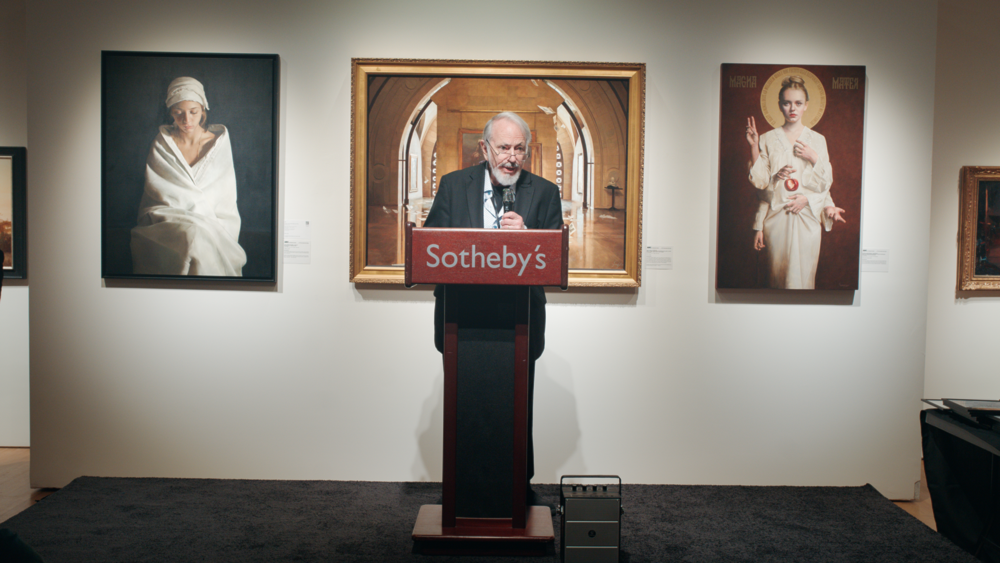
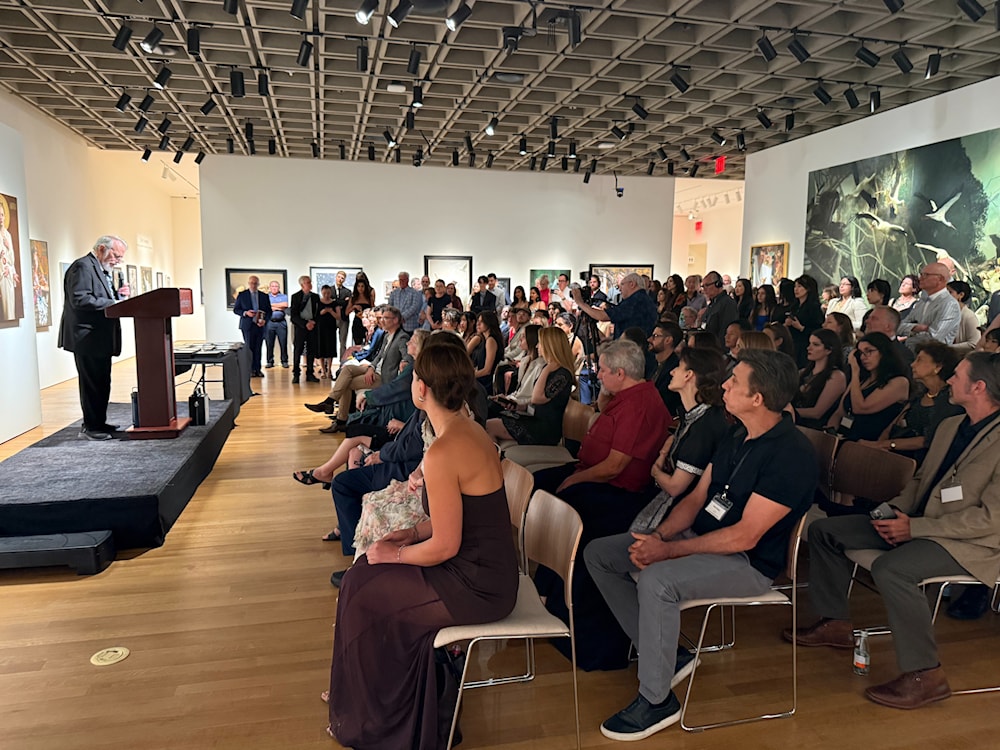
Sotheby’s New York, July 17, 2026
In 1939, The Museum of Modern Art (MOMA) celebrated the opening of their new Museum and, no less than the President of the United States himself, Franklin Delano Roosevelt spoke at the opening. There and then, he consecrated Modern, experimental and abstract art as uniquely American as it demonstrated that in America you were free to do anything. He didn’t address the question whether literally “anything” is worth doing.
It is in fact the only time in American history that a sitting President spoke at the opening of an art museum giving it his blessing and Presidential prestige and power.
This occurred the same year World War II started after Stalin and Hitler agreed to divide Poland between them. The Nazis and Communists at the time were brutally and oppressively controlling the accepted subjects of literature, education, culture and art and those who defied them were imprisoned, tortured or slaughtered. The Nazis only wanted classical heroic art demonstrating their image of a superior Aryan race, and the Communists only permitted socialist realist art that was anti-capitalist and glorified the proletarian workers. While it would have been perfectly possible to show that Americans were free to choose any subject matter regardless of whether it was for or against any political or economic agenda, or engage subjects that had nothing to do with any specific world view, instead, the US government chose to back deconstructive abstract art as representing our freedom, and to that end 1,000 emissaries were sent throughout America and the world by the US Government and the CIA proselytizing for modern and abstract art. The irony is that this actually suppressed the creativity of the skilled and well-trained representational artists of the time. Rather than giving them freedom, it imposed artistic control by the government, basically ostracizing narrative artists who used their knowledge and skills to paint scenes about life and the real world.
Professor Michael Pearce lays much of this out in his recent well documented book titled “Kitsch, Propaganda and The American Avante Garde,” which shows how the Roosevelt Administration used Modern and abstract art as organized propaganda paid for by US taxpayers. “This wasn’t just a museum opening, it was a declaration of US art policy, a wedding ceremony binding the individualist avant-garde to the state as American art, which would be delivered to the audience of the world through extensive propaganda campaigns.” More than anything else this explains why Representational fine art has for most of the past 100 years been overshadowed by Modernism, a product that has been celebrated for trashing and degrading all of the elements that have defined fine art for thousands of years. They have called this creativity. Mankind has always considered actual creativity and progress as generating order out of chaos. In the book of Genesis, God created the heavens and the earth and the natural order of the universe, separating light from darkness. God gave mankind domain over the Earth and Adam and Eve the job of naming all the plants and animals. Whether you believe it literally or symbolically humanity's God given responsibility was to rein in the chaos and bring order to the world……and he saw that it was good.
But in 1939, the government considered it progress to turn human nature on its head and support art that championed make chaos out of order.
It would have been no different than if the government had backed atonal music or just cacophonous noise as proof of American freedom and denigrated performances of Chopin, Beethoven and Tchaikovsky…or if they replaced great poetry with incoherent vocal sounds.
Or if they replaced the Ballet with people doing unchoreographed random awkward movements.
In fact, the use of the term “abstract” is a complete misnomer. Abstract works are not actually abstract.
The term abstract means when one thing represents something else. A blueprint is an abstract of a building or floor plan or electrical circuitry. An abstract of a patent application is a summary of the invention with illustrative images and a description of what it does. In other words, “an abstract” is when one thing represents something else. What does a de Kooning, Miro or Pollock represent? Perhaps at the most, entropy or chaos? Or are they really just drips and smudges or smears and splatters of color on a flat surface? That’s the so-called “truth” about art that Clement Greenberg or Hilton Kramer claimed they were capturing. Meaning was supposedly left to the viewer and individual interpretation. But in fact, all of the efforts of humanity work in the opposite direction. We bring order out of chaos. We work against entropy and build homes, cars and roads, computers, skyscrapers, airplanes, rocket ships, generators that power electric lights and an endless array of appliances and machinery. We built the pyramids, the Suez Canal and the Great Wall of China. We invented antibiotics, CAT scans, and open-heart surgery, and have doubled the average life span. We invented agriculture and speech, theatre, television, movies and the internet, and culturally we created literature, poetry, music, dance and fine art to communicate all human experience, to express beauty and truth and to imbue life with purpose and meaning.
I therefore tell you that abstract art is not actually abstract. They've stolen it's meaning. But if it's not abstract, what is it? And the one word, the one concept that pulls it all together is the word CONCRETE. Abstract art is actually concrete. It's concrete dabs and streaks, splashes and blobs and smears of paint on a canvas and everything about it shouts "Look at me, I'm telling you the truth. Painting is nothing but a flat design of color and shapes". It’s concrete.
Is this really the truth of what fine art is? That makes as much sense as saying Shakespeare, Dostoevsky, Dickens and Robert Frost were liars because after-all writing is nothing but shapes and black squiggles on white paper. The meaning in their words, the beauty in their form and the ideas and concepts expressed don't matter. it's the black squiggles on paper that are the truth of writing. How many books do you think would be sold with meaningless black squiggles on every page?
This analogy is actually quite exact and unmasks the truth behind abstract, and modern art.
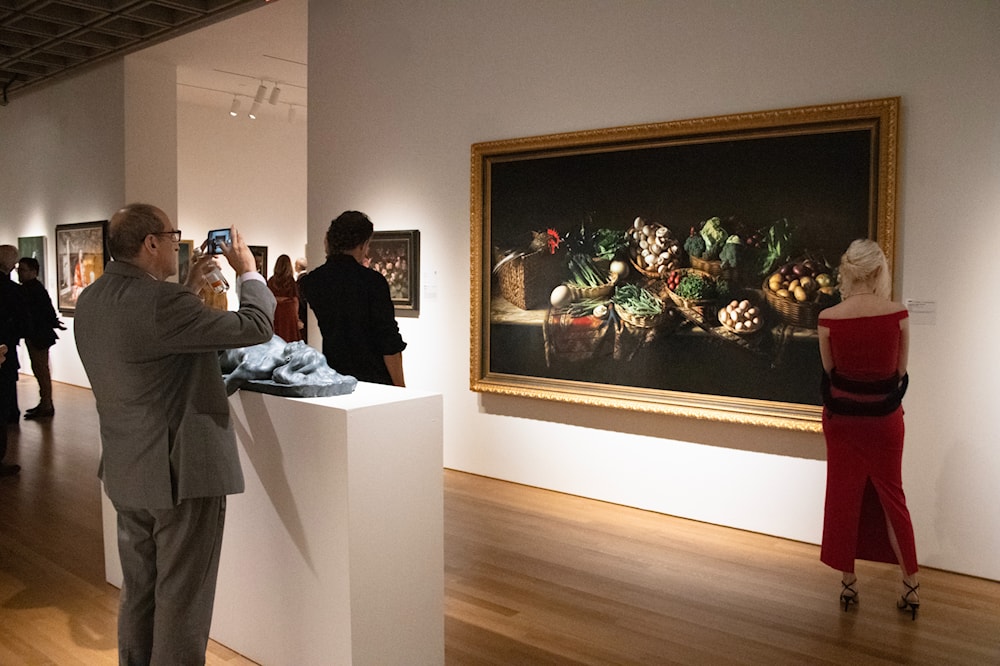
We humans see the world in three dimensions. The potential that exists in pencil, charcoal, and paint as mediums only have that potential actualized when it successfully creates three dimensional illusions which exponentially increases the power of subject matter, since three dimensions is actually how we all see the world. Fine art, just like spoken and written language, evolved primarily as a form of communication and the more successfully any form of communication describes and replicates human experience the more meaningful and compelling it is to people who share it.
And communication only takes place when the listener and speaker, the writer and reader, and the artist and the viewer share a common language. But with speaking, writing and reading there are hundreds of languages and without translators, communication can’t take place. Therefore, Realist fine art is the one universal language which can be understood by all people of all time regardless which language they speak and write.
The definition of Literature is the body of written works that have artistic, intellectual, or lasting cultural value. It includes creative writing such as novels, poems, plays, and short stories, as well as other forms of written expression that explore human experiences, ideas, and emotions.
Doesn’t this correlate directly to the definition of fine-art as well?
What does a Botticelli, a Bouguereau, Goya, Vermeer, Waterhouse a Rembrandt or Caravaggio represent? Different aspects of that shared human experience. The human condition itself, is the essential subject of all great literature, poetry, fine-art and theatre. The loves, the dreams, the hopes, fears and suffering of humanity. Heaven’s highest virtues or the 7 circles of hell. Whether our subjects are poverty and war or the lives of ordinary or extraordinary people; whether it’s science fiction, fantasy, miracles or salvation itself? Their works are true abstractions of our shared humanity. All meaning in life comes from making order out of chaos. Modern art reverts back to the chaos and endlessly celebrates it as if it’s a form of genius.
A great DaVinci, Rembrandt or Bouguereau took weeks or months. A Vermeer, Leighton or Alam-Tadema demanded planning, sacrifice, discipline and creative genius. Great works of art are rare. They cannot be mass-produced.
But a canvas of streaks and splashes and smudges? That can be made in hours. In minutes.
If critics declare it genius and museums hang them with reverence, then galleries can sell them at staggering prices. And there is no end of supply. Every hour another canvas. Every day another “masterpiece.”
Now let me stop here for a second and make one thing clear. Our rights and freedoms are more important than even great fine art. So, if people wish to splatter paint on a canvas and call it great art, and others want to purchase it regardless of price, they are free to do so in this country as they should be. We are also free to call them out just the way we see it. I would never want to ban modern art the way most University art departments and Museums banned contemporary realism from World War II until the past 20 years when representational art has been steadily re-emerging.
By elevating the quick and easily mass produced above the time consuming and masterful, they created a financial machine. An endless conveyor belt of product, dressed up as being profound and sold at ever more preposterous prices. Bouguereau was incredibly productive painting roughly 838 finished works in his 80 years on this planet and Alma Tadema a little over 400. Do you know how many Picassos there are? Over 50,000 with a combined valued at over 120 billion dollars which is roughly equal to the value of General Motors and Ford combined. Interestingly, Bouguereau, Gerome and Lord Leighton paintings are as undervalued today as Rembrandt’s and Caravaggio’s were in the late 1800’s when they sold for far less than works by Joshua Reynolds, George Romney or Thomas Lawrence.
From the very first handmade drawings on cave walls, humanity sought to communicate across time. Those markings were not primarily decoration. They were language. They said: “We were here. This is what we saw. This is what mattered to us.”
Before the printing press, before even alphabets, there was art. And the attempt to represent the world and human experience has always been its clear intent.
You, artists here today, are their heirs, their legacy. When you paint the sorrow of a mother, the innocence of a child, the strength of a worker, or the pain and terror of a slave, you speak a truth that crosses centuries and continents and all human history.
And that is why realism is not easy or parochial. Its best examples are profound, compelling and universal. It is our shared inheritance.
When you, as realist artists, use paint to conjure a child’s face, or the movement of a dancer, or the sorrow of a widow, you are transforming substances into something that represents the real world on multiple levels: the physical, emotional, psychological and spiritual. You are performing the true act of abstraction.
Realism is the highest form of abstraction, because it uses materials and different mediums and brings them to life, with order, spirit, soul, meaning and purpose.
And the US Government used the CIA - actually it was called the CIAA or Central Intelligence Agency Arts, to establish Modern art throughout the country and throughout the world as American propaganda and taxpayers footed the bill. Uncle Sam put his foot on the scale to denigrate Realistic fine art. What kind of bizarre twisted use of government power was this?
But here is the miracle: you are here. You have not forgotten what art is supposed to be. You have chosen the harder path — the path of skill, discipline, and beauty. Your work cannot be mass-produced. It cannot be replaced tomorrow by another pail of thrown paint. It takes time, patience, commitment and love. And that is why it has meaning and what you create really matters.
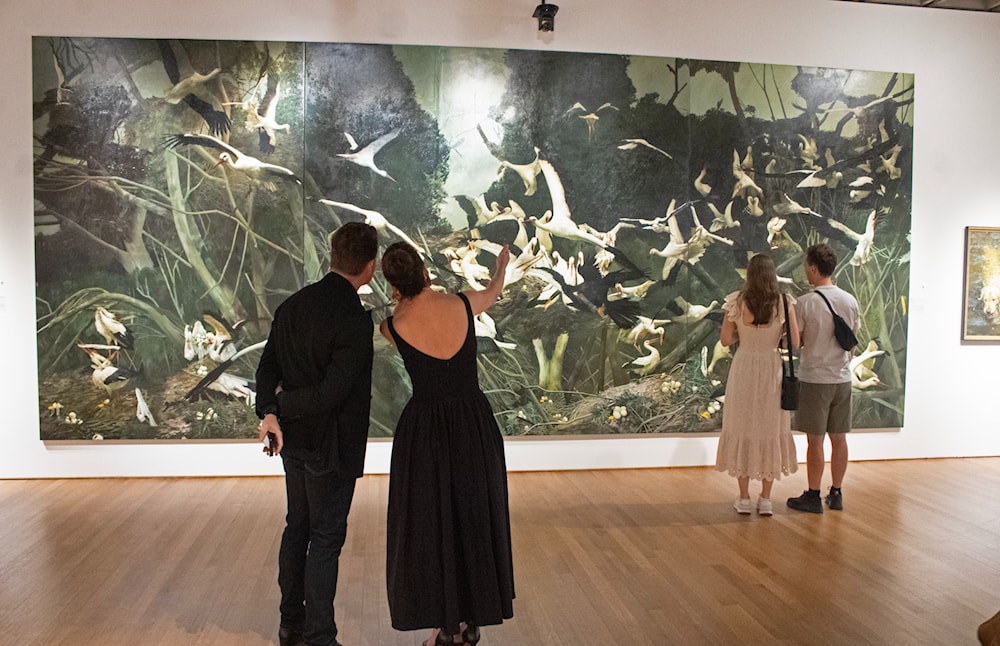
When people stand before your work, they feel that universal language again. They remember that art is not just decoration or worse just a financial investment. It's not bit coins. It’s communication of life, imagination, ideation and experience.
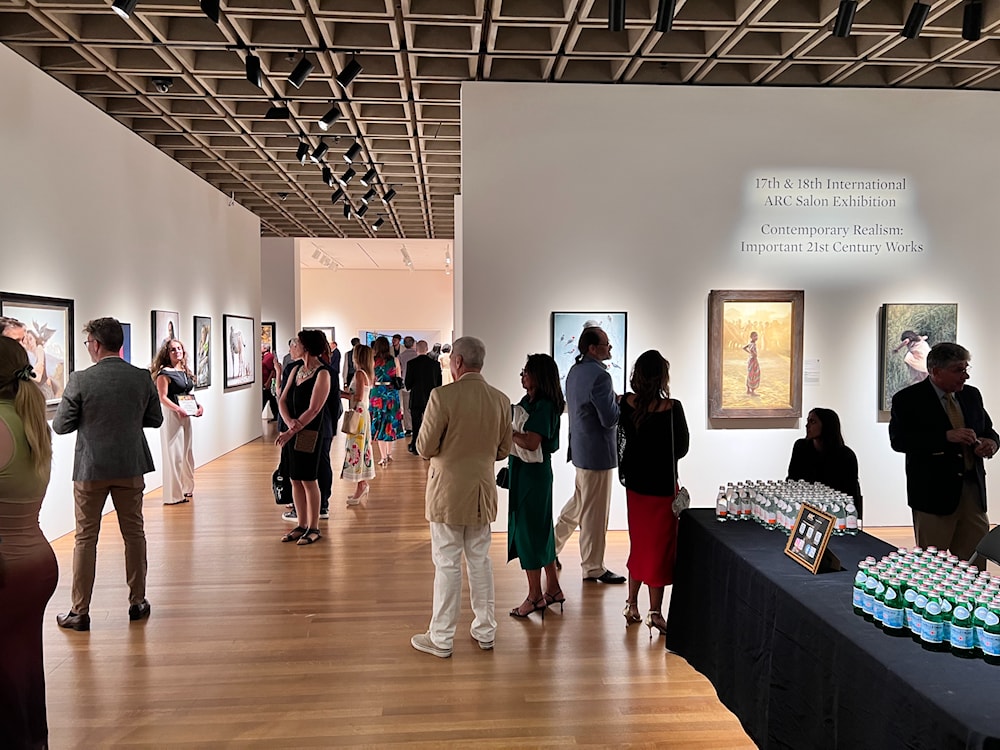
The second miracle is that since the founding of the Art Renewal Center, skilled and highly trained artwork has exploded exponentially. From a tiny handful of schools, only 14 in 2000 with less than 200 total students, today there are 100 ARC Approved art ateliers, Academies and programs, as well as scores of additional schools that are incorporating skill-based lessons into their curriculums, all teaching thousands of students each and every year. From a mere handful of perhaps 50 well trained artists at the end of the 20th Century, today there are tens of thousands of artists who have mastered the crafts needed to bring their subjects and ideas to fruition with poetry, beauty and grace. The 21st Century Representational Art Movement is occurring worldwide as this exhibition clearly demonstrates, and there are hundreds of dealers representing the best of these artists who are once again making their life’s dream also their life’s work.
Furthermore, I very recently learned that the new George Lucas Museum of Narrative Art is due to open in California later this year. In their opening exhibition they will be exhibiting works by Julie Bell and her husband Boris Vallejos. Julie, I might add, has won more awards in past ARC Salons than any other artist, and she has been asked to sit on the 9-person Board of Advisors of this new Lucas Museum that apparently cost over a billion dollars to build and looks like a spaceship. Who can doubt the renewal and revitalization of Humanist, narrative fine art is well on its way. Purchasing works by the best living artists today will be like buying the Impressionists when they were creating their works.
Let us all show in our work, what we value as artists and as human beings. Just as the great masters of the past showed it in theirs, that images of life and humanity, are what have the highest value.
And let us continue step by step to reconstruct what is ordered, what is good, what is true, what is beautiful. For that is not only the artist’s, writer’s and musician’s task — it is humanity’s calling.
So, defend beauty and use your skills without apology. Know that you stand in the lineage of the Renaissance, the Enlightenment and a thousand generations who worked to create the most advanced successful civilization that has ever existed.
You are speaking in that universal language of humanity and you are the saviors of one of civilization's greatest achievements: the fine arts of painting, drawing, and sculpture. You all deserve consummate congratulations.
Continue to express the story of humanity and do it with love…seeking truth and beauty… and with a passion driven by deep purpose, and profound meaning.
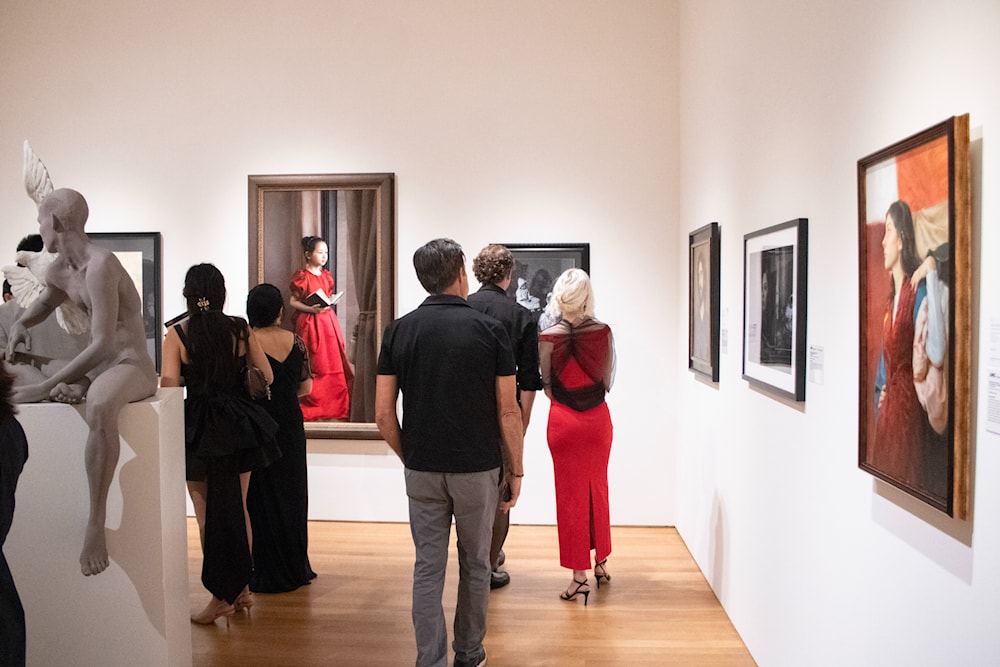
I want to welcome you all to this very special occasion which is beyond doubt, a watershed event in the history of fine art and the Art Renewal Center which has now achieved government recognition as a full Public Charity.
I want to thank Sotheby’s for hosting the ARC Salon during its month-long celebration for the 250th anniversary of our country’s founding. and I want to especially thank Ben Doller, Sotheby’s Chairman, who has been a friend and colleague for over 40 years, as well as our liaisons Jaden Katz, Lily Winkleman, Ali MacQueen, and the rest of the exceptionally competent and expert team here. As for our people I want to thank especially Doctor Vern Swanson, who has been there as a cherished friend since 1980, and an advisor since ARC’s founding in 1999, his daughter, Angela Swanson Jones who has been a great addition to our team over the past few years and an indispensable help for this year and last year’s competitions. Both are well published art historians. I want to thank our technical lead Iian Neill, also with us since our founding and the long-term key members of our staff Yvette Lytle, Frank Gatti, Michele Carnevale, and Sabrina Foland for their tireless work in making this all possible. I also want to thank the MacAvoy Foundation for sponsoring our Best in Show winners and the MacAvoy Purchase Awards and Brigette MacAvoy who has proven to be a solid juror and has also volunteered her time as a member of our staff. I want to give the biggest of all very special thanks and credit to my daughter Kara Lysandra Ross who did the lion’s share of work and effort organizing the yearly ARC Salons for the past 16 years. Unfortunately, due to a sports related injury she can’t be with us tonight, so she asked me to thank everyone for her as well and give everyone her congratulations and very best wishes. I also want to thank all our other jurors for contributing their time and expertise in this monumental task.
I want to congratulate all of the winners, honorable mentions, finalists and semi-finalists all available to view on our website at arcsalon.org.
Finally, I want to thank all of the exhibiting artists and members of their families and patrons who have loaned works to the exhibit, and who came from all corners of the earth to be here today.
