

William Bouguereau and The Real 19th Century
Bouguereau Articles
- Biography of William Bouguereau by Damien Bartoli and Fred Ross
- William Bouguereau and The Real 19th Century by Fred Ross
- Bouguereau Revisited by Fred Ross
- Introduction to the Catalog Raisonné of William Bouguereau by Fred Ross
- William Bouguereau and his Religious Works by Kara Lysandra Ross
- Bouguereau at Work by Mark Walker
- MIA Shamefully to Sell Masterpiece by Bouguereau by ARC Staff
In 1900 at the Universal Exposition in Paris, it is reported that Degas and Monet were approached by a newspaper reporter who asked who, in their opinion, would most likely be considered the greatest 19th century French artist in the year 2000. After a brief debate, both agreed on one man — William Bouguereau .
What did these two geniuses of French Impressionism see that their chief followers and supporters over the next hundred years did not? For Bouguereau, a true genius of the art of painting, was soon to fall so far from grace that art history students in the 1940s through to the 1980's could study 19th century art and never hear his name, or see one of his paintings.
For over ninety years there has been a concerted and relentless effort to disparage, denigrate and obliterate the reputations, names, and brilliance of the Academic artistic masters of the late 19th century. Fueled by a cooperative press, the ruling powers have held the global art establishment in an iron grip. Equally, there was a successful effort to remove from our institutions of higher learning all the methods, techniques and knowledge of how to train skilled artists. Five centuries of critical data was nearly thrown into the trash. It is incredible how close Modernist theory, backed by an enormous network of powerful and influential art dealers, came to acquiring complete control over thousands of museums, university art departments and journalistic art criticism. We at the Art Renewal Center, and with the help of many colleagues and scholars around the world, have fully and fairly analyzed their theories and have found them wanting in every respect, devoid of substance and built on a labyrinth of easily disproved fallacies, suppositions and hypotheses.
Allow me to try to characterize how I first came upon this recognition.
Just imagine for a moment that you are a lover of great Classical Music, and among your favorite composers were Bach, Mozart, Haydn and Handel. Suppose you're even a music major, and get your master's degree in that field. Then imagine that in spite of that, you had never heard of Chopin or Beethoven, nor ever heard any of their music. Imagine that both of those artists had been methodically maligned and denigrated in the description told to you by a Modernist music establishment. At the most, you'd heard that they were from a small but powerful group of composers who had run the music world, and who didn't appreciate the greatness of Shostakovitch or Bartok, who had ultimately led to the genius of John Cage. You were taught that Chopin and Beethoven were petty academics who wrote romantic, sentimental, inane, vapid, maudlin and silly works, and you were never exposed to, nor was it arranged for you, to listen to any of their music.
Then imagine that a few years after graduating with your Master degree in music, you went to a concert and heard some of the most intensely beautiful works of your life, with incredible orchestration with profound emotionality, equal or better than you'd ever before experienced. You were awestruck with an overwhelming sense of beauty coming from the minds of obviously consummate genius. Quickly you look at the program and see the names Frédéric Chopin and Ludwig von Beethoven; and remember, you're imagining that you'd never heard those names before. The next day you run to the library and find out that they were two of the villains who ran the 19th century music world, who you had been told had no talent and whose music was mindless, shallow and vapid.
But you knew what you'd heard, and what had been written made no sense. Next you run to a music store and find their work on some rare CD's and start listening to everything you can find by them, and despite everything written in the music history books, and everything you'd been taught about them, you were certain in the deepest recesses of your heart, you were certain beyond the slightest shadow of a doubt, that you had discovered two of the greatest musical geniuses in all of history. Racing through your head are an endless barrage of questions, and outrage. How could such masterpieces ... self-evident ... a priori ... self-validating, consummate, masterpieces have been so maligned, that were written by artists who were not just overlooked, or accidentally forgotten, but who were maliciously targeted to be attacked, degraded, and ridiculed ... and the main reason was because they were accused by the modernists in today's music establishment of having not appreciated the genius of atonal music.
So you started searching for every sonata, nocturne, symphony, and concerto you could find that Beethoven and Chopin had ever written. Perhaps you had only just happened to have heard the only good works they had ever written, a "one time" lucky work where they'd hit it, but they really were all those bad things that had been said about them. And then, as you uncovered work after work after work, you discovered that nearly everything they'd ever written during their mature years were as great, or greater, than the first pieces you had heard at that one concert.
Wouldn't the world seem like it was upside down? The professors and authorities who you had depended on to teach you truth and beauty had literally done nothing more than teach you the party line and a truckload of libelous propaganda, for reasons you still could not fathom.
Well this, ladies and gentlemen, is precisely what happened to the works and reputation of William Bouguereau, as well as many other great artistic geniuses of his time. And this little story is nearly an exact rendition of what I experienced when I studied art and art history when I earned my Bachelor's degree at Brandeis, and then my Master's of Art Education from Columbia University in 1974, just a couple of miles from here.
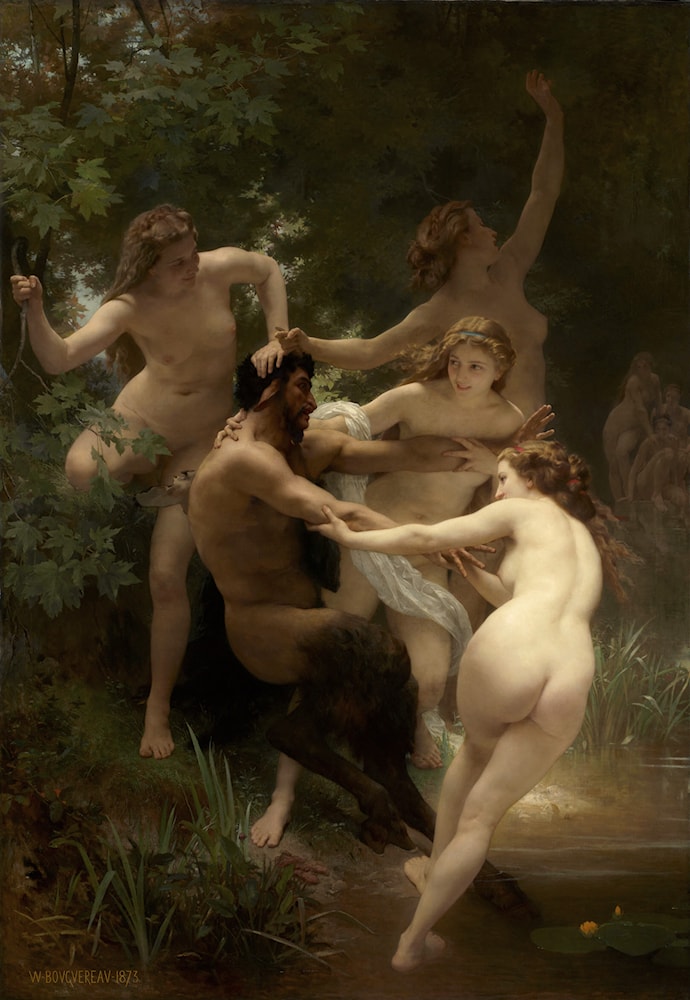
In October 1977, I walked into the Clark Museum to see their thirty Renoirs, and after leaving the Renoir galleries walked out into a major hall, at the end of which was a painting that grabbed me body and soul. It was a life-size painting of four water nymphs playfully dragging a mythological satyr into a lake against his will. Frozen in place, gawking with my mouth agape, cold chills careening up and down my spine, I was virtually gripped as if by a spell that had been cast. It was so alive, so beautiful and so compelling. Finally, after about fifteen or twenty minutes of soaking up wave after wave of artistic and spiritual ecstasy, I started to take back control of my consciousness ... my mind started racing with unanswered questions. My first thought was "I haven't felt this way about a work of art since I stood before Michelangelo's David. Then I thought, "This must be one of the greatest old master paintings every produced. But no name or country or time would come to mind. Italian High Renaissance, 17th Century Dutch, Caravaggio , Fragonard , Ingres , Prud'hon ... back further perhaps ... Raphael , Botticelli , Leonardo , no! no! NO! Not one of those names or times felt anything like what I was looking at.
Then I approached the painting more closely, and saw the name mispronouncing it as Bouguereau at the bottom, and the date 1873 — 1873?
How was that possible? I'd learned that the greatest artists at that time were, Manet , Corot , Courbet , and Renoir ... that the techniques and greatness of the old master's had died out, and that nobody knew how to do anything remotely this great by the 1870's.
Years of undergraduate courses and another sixty credits post graduate in art, and I had never heard that name. Who was he? Was he important? How could he not be important? Anyone who could have done this must surely be deserving of the highest accolades in the art world. Then I asked the guard if they had any more works by him, and he asked somebody else, and I was led to a second work of a single female nude, seated by the water holding her knees. It was one of the finest nudes I had ever seen.
In somewhat of a state of shock from this experience, I decided that I must find out if this artist ever comes up for sale at the largest auction house in New York, Parke Bernet who was years later bought out by Sotheby's. Was he deemed important enough to be sold at auction? My only experiences collecting up to then at auction was to purchase a few etchings by old master's: Rembrandt , Durer , Brueghel and Goya . But they were very famous names.

I was at the Clark on Sunday October 2nd 1977, I stopped in at Sotheby's that Tuesday October 4th, and as fate would have it, there were three Bouguereau paintings being offered for sale that coming Friday. I purchased one called Les Enfants Endormis, of two babies asleep in each other's arms. The hands of fate certainly seemed involved, for later I learned that these were the first Bouguereaus to come up for sale in the last eighteen months, and another was not to appear on the auction block until twelve months later. So the timing could not have been any more precise for fortuitous. I remember too, there was an energy of excitement in the air, and I somehow knew that I would never again be able to purchase works by these artists at these prices. But I didn't know which ones to buy.
And I still didn't know who he was. During the next few weeks I started researching Bouguereau and the entire period as much as I could using any free time I had.
But almost immediately, I discovered that he had won the Grand Prix de Rome in 1851 at the age of twenty-six, and after winning nearly every accolade and award imaginable for an artist of his time, ultimately become the President of the Academy, Head of the Salon, President of the Legion of Honor. He was in fact, considered the greatest French artist of his time, and Paris was the center of art world. All this made me feel very good about my instincts, and that I had intuitively identified as being one of the world's greatest artists somebody who had generally been considered as such by most of the world during the final decades of the 19th century.
As an aside, consider this interesting article in the New York Times, published April 7, 2000, by Katie Hafner:
Lenn D. Lowry, the director of the Museum of Modern Art (let me repeat "the director of the Museum of Modern Art"), has a vivid memory of the first time he was profoundly moved by a work of art. At age 7, during a visit to the Sterling and Francine Clark Art Institute in Williamstown, Mass., he was separated from his parents.
While wandering in search of them, he came upon a huge painting, Nymphs and Satyr, by William Bouguereau. His parents found him a half-hour later, still staring at the 6-by-8-foot painting. "I just remember being completely transfixed by it," said Mr. Lowry, who is now 45.
The experience helped Mr. Lowry believe in the transformative power of art and what he calls the "unique encounters that occur when one is fortunate to confront directly an extraordinary object." Mr. Lowry, as well as other museum directors, wants to broaden the opportunity for such transforming moments by providing encounters with virtual art, viewed on a computer screen and brought to the art-viewing public via the World Wide Web.
Ironically, this is exactly what we've done at the Art Renewal Center, which you can all find at www.artrenewal.org.
I can't help but wonder why Mr. Lowry after having such a similar experience to my own with the same exact painting, has not aided in the resurrection of academic art. But many with careers in the art world are intimidated, and afraid to speak out against accepted gospels of Modernist theory.
It didn't take long before I discovered a lot of other major names that I'd never heard of before: Jules Joseph Tissot , Alexandre Cabanel , Jules Lefebvre , Ernst Louis Meissonier , Jean George Vibert , Jean Léon Gérôme , Léon Bonnat and Léon L'hermitte from France, — and John William Waterhouse , Dante Gabriel Rossetti , Sir John Everett Millais , Edward Coley Burne-Jones , Sir Lawrence Alma-Tadema , Frederic Lord Leighton , and Frank Dicksee from England, and scores of other artists all across Europe and American about whom I had never learned, never been taught, and never seen any of their works, even though I had paid for and studied art history at what was supposed to be one of the foremost educational institutions in America ... Columbia University.
Ultimately I concluded that this was one of the most despicable examples of bias and prejudicial propaganda being passed off as education and art history. Ninety-nine percent of what was going on and what made up the art world between 1850 and 1900, was not Impressionism and post-Impressionism, but all of these other schools, artists, and styles. The 19th century due to freedom, democracy, and the systematic codification of the breakthroughs of Enlightenment thinking, in fact saw the greatest explosion of styles, subjects, and experimentation in all of art history including expansion and developments both technically and thematically that had ever occurred before. Yet, this was the period characterized as oppressive, narrow and superficial? The exact opposite was the truth.
It was systematically suppressed by the 20th century art establishment. Before I saw Bouguereau's Nymphs and Satyr I thought that the methods and techniques of the great old master's had somehow been lost. It never had occurred to me for two seconds, that people could actually have deliberately destroyed and eviscerated all of the institutions and methods by which the knowledge could be gained of how to create great works of art. This is one of mankind's greatest achievements ... one of the defining characteristics of advanced civilization ... that makes us so unique, so sophisticated and so special. We're talking about the great arts of drawing, painting and sculpture, through which it's possible to express our shared humanity, including all of the universal, profound, complex and subtle emotions of what it means to be human: our hopes and dreams, our fears and fantasies, our jealousy, and joys, our grief, loneliness, expectation, insecurity, intrigue, compassion, and betrayal.
This is what art is for; whether in theatre, in music, in literature, in poetry, or in painting. And this is precisely what the idiotic theories of modernism decided were uncreative, confining, sentimental, obsession with technique, empty story telling, and worthless. In other words, modernism didn't attack academic art. It attacked art itself. All art was without value, because the essence of what art is, the communication of our common humanity, was banished from the entire field, from the art schools, and museums, and it was all supported by journalistic art criticism, which was also held hostage by the same insanity. And it was all paid for by a growing network of dealers who were making untold fortunes by hiring clever writers to justify their products that could be produced now in minutes and hours instead of weeks and months. And these works the public was told were not only as good as what had come before, but far better. Bouguereau was incredibly productive, painting an average of sixteen to eighteen paintings per year during his prime. But his dealer Goupil had a list a hundred deep, of wealthy collectors waiting for his work. Everything was sold long before it was finished. Dealers for these great academics sat biting their nails waiting helplessly for the products they needed to sell. Well, what kind of business is that? Any good business man knows that if you have ten of something and can sell two hundred, that you'd better get out there and find the other one hundred and ninety so that you can meet the demand and maximize your profits. But with the demand of the works by a specific artist, you can't go anywhere else except to that artist.
What a great solution Modernism had for this problem. Dealers welcomed it with open arms, and as the Academy and Salon fell into disrepute, they were the ones who took over the direction of art, and their advertising dollars made sure that the press played ball. So they celebrated artists and art forms where supply could keep pace with the demand that they were creating. Bouguereau painted eight hundred and twenty-six paintings, and fully seventy-five percent of them are master works of the highest level and half of those are full blown masterpieces. But it was still only eight hundred and twenty-six paintings. Alma-Tadema only produce four hundred and thirty-five during his life.
Do you know how many works were produced by Picasso? — more than eighty thousand.
Hell, for a while there during the 1960's and 70's, every self-respecting member of the upper class and even many in the upper middle class had their own Picasso that they could show off to their friends.
Now let me systematically deal with the things that have been said about Bouguereau; the inaccuracies, the myths and the out and out lies that have been incorporated into the religious and fanatical canons and scriptures of modernism that have been passed off as scholarly and historical text books Ö but are really no more than large propaganda brochures. In Modernism's religious zeal, not only women are forced to hide behind a veil. All mankind along with our experiences, our feelings, and emotions, our dreams and passions are also forced to stay hidden. But, instead of a veil, we're all hidden behind a wall of splattered paint or twisted girders.
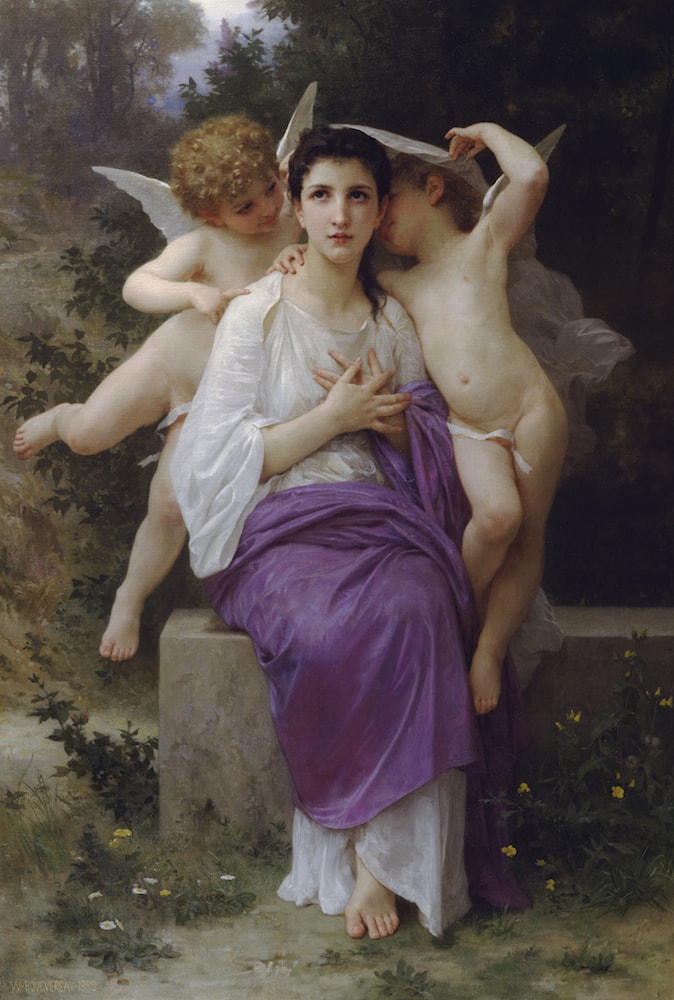

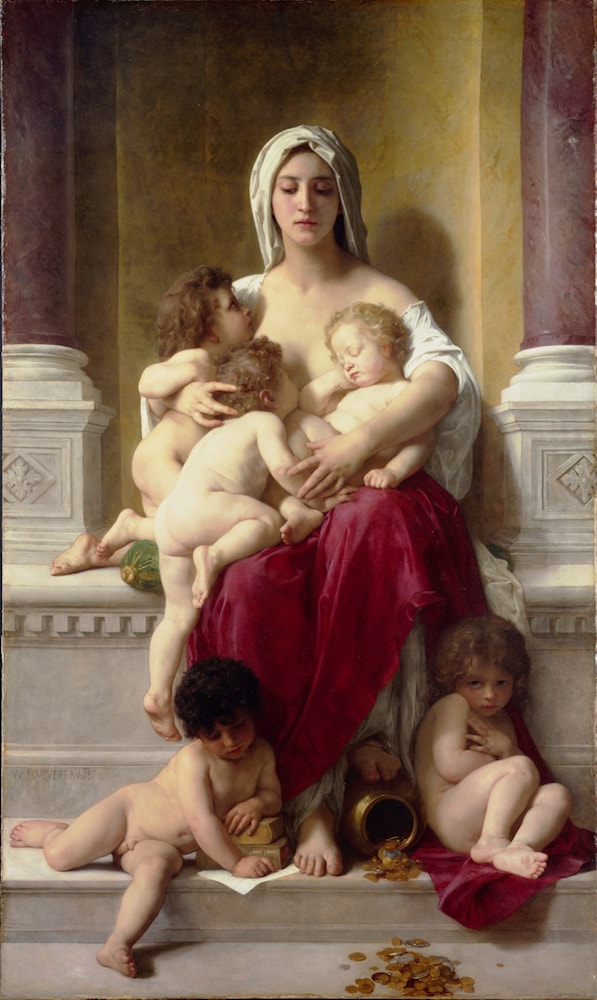
By the 1940's, nearly all museums around the world had taken Bouguereau's paintings down, putting them in attics and store-rooms where they were uncared for and collected dust for the next sixty to seventy years. Or worse, they sold them off at bargain-basement prices as if nearly worthless. Now, in the twilight of the 20th century, and the start of the 21st, Bouguereau is once again attaining the respect he so richly deserves. A major retrospective of his work was organized by the Montreal Museum and traveled to Paris and Hartford in 1984. Scholars, curators and historians have been reevaluating his work, and though he is still held in contempt by modernists, a growing crescendo of supporters have welcomed his return. And since 1975 his prices have climbed steadily by over five thousand percent in twenty-five years, with major works of his selling for example $1,500,000 in 1998 for The Heart's Awakening, $2,600,000 in 1999 for Alma Parens and Charity sold at Christies in May of 2000 for $3,500,000. And now, over one hundred museums throughout the world have Bouguereau paintings on permanent exhibit.

Bouguereau was not only loved by the general populace, he was adored and revered by other recognized giants of his own time, including men like Henry James, Charles Dickens, Edgar Degas and Frédéric Chopin. Are we to believe that these recognized geniuses in their own fields had such bad taste and judgment? But just as Rembrandt was relegated to near oblivion for over one hundred years after his death, so too was this to be Bouguereau's fate. One of the most famous stories about Rembrandt concerns his painting Night Watch. No one wanted it. Finally, a gymnasium agreed to hang it on their back wall if the top foot of the painting would be cut off so it would fit. To this day, we know this masterpiece only in this mutilated form. Bouguereau, until the mid-1970s, was equally denigrated, and his return is being fought tooth and nail every inch of the way.
Another major myth was the claim that Bouguereau and his colleagues were not relevant to their times; that they only copied the styles of earlier times. This argument is without a shred of truth. Bouguereau was born in 1825, shortly after the American and French Revolutions. These upheavals were the most tangible results of the new ideas generated by the Enlightenment. Whereas earlier centuries were controlled by ideas of the primacy of religion and monarchs ruling by divine right, instead, in the 19th Century major philosophical and political writings held the day, like John Locke's The Rights of Man, Thomas Hobbes' The Leviathan and Alexis de Tocqueville's Democracy in America. Instead of religious paintings, illustrations of historical events and portraits of the aristocracy and nobility that dominated the 15th, 16th and 17th and 18th century, with the new democratic philosophies, came the ascendance of interest and respect for all mankind. "Liberté, Fraternité, Egalité," cried the French; and the Americans, "We hold these truths to be self-evident, that all men are created equal; that they are endowed by their creator with certain inalienable rights, the rights of life, liberty and the pursuit of happiness." These words perfectly sum up the new philosophical and sociological advances of Western civilization that occurred in the late 18th century and that were being popularized and codified in the 19th. Both America and France were at the cutting edge of the changing Western world. It is no coincidence that some of the greatest works of art of the 19th century came from these two societies. And with these changing ideas, art too changed, generating many new groups and styles. There were the naturalists like Jean François Millet , Jules Breton , Julien Dupré , and Léon L'hermitte , who showed the nobility of the common man straining under the yoke of a hard life. They tried to show rural life as it really was. There were also the Pre-Raphaelites exploring fantasy, myth and legend, the Social Realists exposing the plight of those trapped in poverty or oppressed by backward and dehumanizing social mores, as well as the English Aesthetic movement that explored beauty for it's own sake. There were the idealists and romantics, who celebrated all humanity in keeping with principles of democracy and human rights. Bouguereau's paintings successfully merge the best from many of these movements in his own unique and original style. In much of his work he uses peasants and gypsies for his subject matter. How fitting to choose society's lowest to exalt all mankind to the highest, for if we could appreciate the value of the peasants and gypsies, then certainly we all must be worth while.

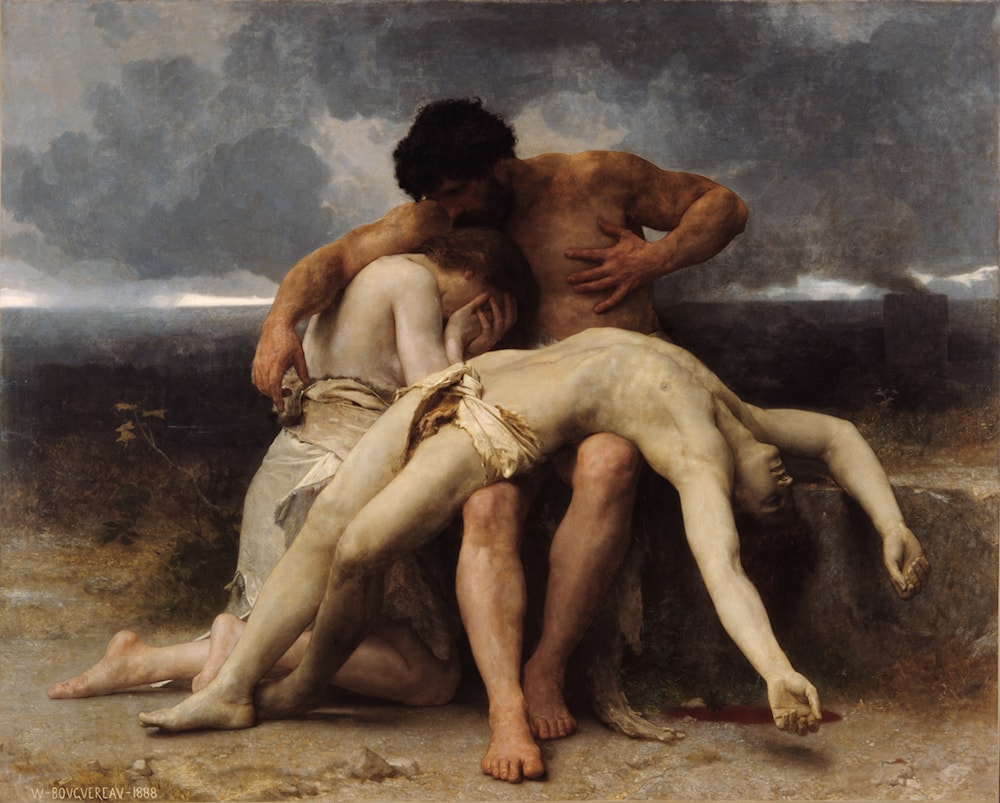
Bouguereau also celebrated humanity's culture and literature in his paintings as seen in his mythological scenes of nymphs, cupids, and angels, and his scenes from literature, legend and the Bible. These wholly original compositions are handled with an emotional force second to none. The Flagellation and First Mourning (Adam and Eve grieving the death of Abel) are all consummate masterpieces, with figures painted so lifelike that you feel like you're looking through a window at an event frozen in time. One can sense the blood rushing in their veins and the life in their eyes, accomplishments for which no words can do justice. It was the artist's goal to show humanity as beautifully real and ideal as possible, encouraging all to strive for such ideals. The message is: Mankind is good and life is good. Implicit is the moral imperative that all people are worthy of love and respect and it is society's duty as well at the duty of each individual to nurture our children and to care for the poor and down-trodden, asserting that each individual was unique and valuable. So not only was it untrue that Bouguereau was irrelevant, the exact opposite was the case. He and many of the other academic artists were at the cutting edge of the changes that were occurring in Western civilization. Only a society with these liberal values could generate people who would even be permitted to dribble paint on a canvas and call it a work of art. A hundred years earlier, somebody trying to do that would probably have been thrown into an institution or worse. We must realize that modern art could never have existed save on the back of the Humanist art and the freedom loving society that preceded it. One can't help but be struck by the irony that the chief benefactors of these liberated and "enlightened" artists are their chief detractors.
The next myth perpetuated about Bouguereau by his critics was that he painted just for the bourgeois in order to get rich. Let's dispel that once and for all. He prided himself in never having to take commissions. He painted what he loved and believed in, often laboring sixteen hours a day, seven days a week, much like Michelangelo . His fame became so great that his dealer, Goupil, was able to charge $10,000 for a single canvas (equivalent to more than $300,000 today). The bourgeois couldn't possibly buy his paintings, but they were eagerly acquired by the wealthy: Mellons, Vanderbilts, Frick's Carnegies and Rockafellas. Let me ask, who has been buying Matisse, Picasso and Gauguin, or even de Kooning, Rothko and Jasper Johns? The Mellons, Vanderbilts, Rockafellas and Carnegies, or their contemporary equivalents. I don't hear the same critics claiming that these artists painted just for the bourgeois in order to get rich. Certainly Picasso was far wealthier when he died than Bouguereau at his death. Rubens , Gainsborough , Church , Boucher , de Kooning, Warhol, and Stella all made or are making substantial sums on their art. The fact is that most often, it is the wealthy who collect art. Rather than using this fact to condemn the artists, it should be the basis for praising those collectors who recognized and helped support greatness. What would the Renaissance have been without Lorenzo de Medici?
Then again, we should ask what is wrong with being part of the bourgeois? The term has been so reviled and vilified, that artists and scholars run for the hills rather than be associated with the bourgeoisie. But, it was their existence more than anything else that helped to create our culture as we know it. The bourgeois mostly came from poor roots, and through hard work and a frugal life style created a dominant and viable middle class upon which democracy and constitutional government depended for survival. And this middle class, the "bourgeoisie" rightly felt that they were as worthy of love and respect as the nobility that controlled government and society before them.
Yet another myth, also completely false, was that Bouguereau's work lacked innovation. In fact, there are incredible innovations in Bouguereau's works. His use of color, built-up layer upon layer through inventive glazing and scumbling, created the illusion of living, energetic figures, along with the subtle interplay of human relations. Bouguereau captured the very souls and spirits of his subjects much like Rembrandt. Often I've heard said that Rembrandt captured the soul of age, well Bouguereau captured the soul of youth. His figures come to life like no previous artist has ever before or ever since achieved. He didn't just paint their flesh better, but he captured the subtlest tender nuances of personality and mood Each perspective he chose was more difficult and original than the last. He masterfully brought together the elements of exquisite drawing, subtle coloration and perspective, sensitive modeling and brilliantly conceived compositions. He took no short cuts His paintings never feel busy. There are never unnecessary elements strewn around. The landscaping is rendered just enough to selectively focus you in on the figures. All parameters worked in harmony to reinforce the poetic and emotional thrust of each subject and theme. To achieve this he developed his own idiosyncratic techniques often creating new methods on the spot to solve an immediate problem. There have been extensive analytic treatises written by a number of recent scholars trying to technically dissect how Bouguereau managed his totally unique magic.
Another myth concerns the accusation that most of Bouguereau's work is just petty sentimentality. In fact, most modernist critics consider any hint of positive human emotions as petty sentiment. I would agree that an adult's abnormal attachment to their high school ring or cheerleading uniform is petty sentiment. But, what of the incomparable joy of a child taking his or her first steps? Is there anything more beautiful, and could anything be more fitting subject matter for art? Or what of capturing the moment when a young person has entered puberty; where one can sense the budding sensuality of the adult, yet still see the trusting innocence of the child? This was subject matter that had never been dealt with before and wouldn't have been deemed appropriate in earlier centuries. Of course, many other academic artists of the period unsuccessfully tried such subject matter and it often did look over-sentimentalized. Bouguereau was one of the few who pulled it off with poetic brilliance. If we claim that these works are petty sentimentality, then wouldn't the same logic apply to the great Renaissance artists who attempted to capture the joys of religious exaltation? Are these types of subject petty sentiment, or are they central to understanding and appreciating what it means to be human? Isn't it really our humanity and all human beings as a species that are the real targets of the modernist assault on representational art?
Lastly, I wish to address the myth that Bouguereau stopped the impressionists from showing in the salons and working at the academies and ateliers. In their youths, Monet and Renoir worked next to the great academic artist Jean-Léon Gérôme in the atelier of Charles Gleyre . Degas was accepted and worked successfully in the atelier of Hippolyte Flandrin and with Ingres . Edouard Manet worked in the atelier of Thomas Couture . And in every salon from 1873 forward there were always impressionist paintings shown. The reason there were only a few during the earlier years was because there weren't yet many impressionist artists. In a typical salon show in the 1870s, of two hundred artists perhaps ten or twelve were impressionists. It was also untrue that van Gogh despised Bouguereau's work. Critics like to point to one letter where van Gogh said that he would be able to sell his paintings more readily if he painted pretty things like Bouguereau. They always conveniently overlook another letter in which van Gogh expresses his deep disappointment that he will never be able to draw as well as Bouguereau. This can readily be found in the published letters of Vincent van Gogh .
In addition, I want to say that I am always amazed at modernist critics like John Russell or Hilton Kramer in the New York Times who will review museum shows of old masters such as Raphael , Caravaggio , Titian or da Vinci , refer to the exquisite drawing, the balance of composition, accuracy of perspective and modeling, subtlety of coloration, and then conveniently fail to notice over-sentimentalized subject matter or over-dramatized gestures. These same critics will then look at Bouguereau, Gérôme, Burne-Jones or Alma-Tadema and totally ignore all of the above-mentioned parameters and with a "double-think" right out of 1984, see nothing but the so-called sentimental subject matter. And have there ever more over dramatized gestures than appear in Picasso's Guernica? But these inconsistencies continue to go unnoticed.

These critics like to say Bouguereau's work is really only derivative, harking back to earlier artists. Only in the 20th century has such a thing ever been scorned. But then again, when we look back to ancient Greek sculpture, we don't ask if Praxiteles may have been derivative of earlier sculptors. All we care about is that he did it the best. And when we talk about the basic criteria and parameters of the academic tradition that built from the 14th through 19th centuries, Bouguereau was second to none.
Bouguereau's second wife was one of his students, Elizabeth Gardener , an American from New Hampshire, whom he had met as a penniless artist endeavoring to seek an art education in Paris, but she was repeatedly turned down because she was a woman. Bouguereau took her into his studio, recognized her talent and the injustice being done to women. This led to a very important fact that has been suppressed. Bouguereau then single handedly, using his immense influence in the art world, first opened up the Academie Julien, and a few years later L'Ecole des Beaux Arts both of which started to admit women for the first time. But this essential fact contradicts the portrait of a villain that the modernists have smeared him with ... so it has been systematically ignored.
In conclusion, Bouguereau and many of the artists of the 19th century exhibited a deep abiding respect for humanity and human feelings; a respect for our minds, our spirits and our reason, and a love of beauty, grace and truth. Bouguereau, Lord Leighton , Waterhouse , Alma-Tadema , Tissot , Burne-Jones and the other giants of the 19th C. tried to exemplify all that is good and decent in our species as well as explore with compassion our weaknesses. Their accomplishments are the quintessential high point of hundreds of years of human study and development in the art of painting. They are arguably the greatest painters that history has ever produced. Bouguereau especially fits this description. How fitting and sadly obvious that he should be characterized as the chief villain by those who would destroy rather than build — who celebrate chaos and would deprive the artist of any skill needed to portray anything.
Do we really want the works of Jackson Pollock, Mark Rothko and Willem de Kooning to be representatives of the best of what mankind can produce? They are a crude hoax. And the public has been for too long subjected to the farce of modernism that has captured and laid siege to civilization's Museums and institutions.
If you are a musical artist in this century and you are moved by something in your life, you can write a moving song about it. If you are horrified by AIDS, appalled by racism, scandalized by government corruption, encouraged by examples of human kindness, exhilarated by beautiful scenery or enthralled with the subtleties of human relationships, you can find beautiful ways of expressing it providing you have mastery over your medium, and a poets soul. If indeed you are a poet or a writer, you can find countless means within the conventions of language to express your thoughts and feelings, and even endeavor actively to effect those people who will read or hear your work. You can use your art to change peoples' minds and even change the world.
But if you are a Modern or Post-modern artist, every possible method of expressing these feelings and ideas has been removed. Story telling, drawing, illusion, perspective, modeling, and harmonious blending of these with color, tone and design are all forbidden to you. Nothing at all from the real world or even your fantasies and dreams is permitted. But in the late 19th Century it is increasingly being recognized that the greatest artists were not establishment old order supporters, but are more appropriately thought of as liberal activists, both for the advancement of our culture and the righting of societies wrongs. They spoke to our hearts and feelings. They expressed: the good and the bad-the beauty of life and the horrors of war — the rapture of love and the fear of abandonment — the joys of family life and the plight of the homeless — the exaltation of nature and the debasement of societies outcasts — the heady heavenly heights, and the steamy fires of hell. All of humanities fear, feelings, accomplishments, problems, history, literature, religion and ambitions were fertile subject matter for the taking. An open book to be drawn composed and painted with a tradition of training and a network of institutions in place to find, nurture and bring to fruition the greatest artistic talents of their day.
I encourage anyone who missed the Bouguereau show in 1984 in Paris, Montreal and Hartford, or more recently at the Newington Cropsey Foundation Museum, to search out his works in any museums you visit. You'll find Bouguereau's works in many American cities and hundreds of locations around the globe too numerous to mention. When you look around, don't necessarily heed what I or anyone else has said about Bouguereau. Rather, look with your eyes and feel with your hearts and open your minds. I believe overwhelmingly that the timeless truth of what this man achieved will be self-evident.
History will lump together those who continue to denigrate Bouguereau with the critics who spurned Rembrandt in the late 17th century. They will ultimately be the recipients of the same ridicule they have so generously poured on one of the greatest artistic minds that Western civilization has ever produced.
